
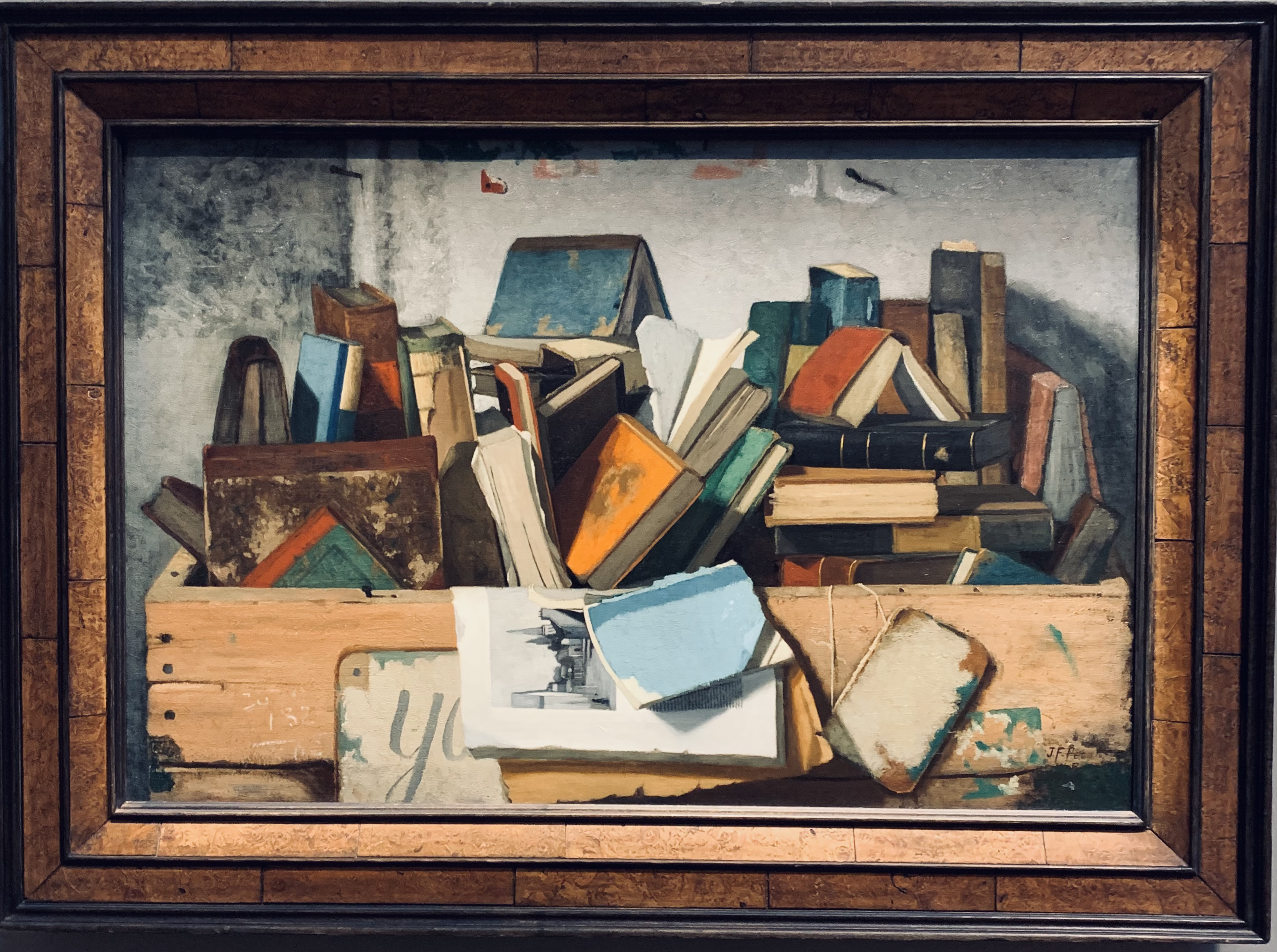
“Take Your Pick” by John Frederick Peto, 1885
Does this sound familiar? You’re doing something boring and repetitive, maybe folding laundry, and an idea pops into your head.
When this happens to me, I drop the shirt I was just hanging up, grab a pen, and write the idea down. I know this seems obvious; after all, I’m a writer. But it wasn’t always so.
Until just a few years ago, my immediate response when an idea would occur to me was to judge it. My criteria were simple: the idea was great or it was terrible. I only recorded the ideas that seemed “great” and ignored the others. As a result, a lot of my ideas flitted away, lost forever.
But then something happened.
On October 19, 2019, I wrote, “I went to St. Vinnie’s to donate a few dozen books I’d removed from my office. It was cloudy and threatening rain. I wore my ‘Oregon’ blue flannel shirt which I bought at St. Vinnie’s last year.”
I’m not sure why those sentences made it past my binary judgment filter. After I looked at what I’d written, I shrugged. There was nothing in those lines that wowed me. Not terrible, maybe, but surely not “great.”
A day or so later, however, I went back to those lines. There was something in their very ordinariness that begged me to try and fix them up. Hmm, I thought. How can I change these lines from dull to dynamite? From trivial to terrific? From flat to fantastic?
As I experimented with those lackluster sentences, something weird and moody began to emerge. It occurred to me that the sulfuric odor I smell some mornings might come from a nearby paper factory, which made the donation of books crafted from paper seem like a small but significant act—as if I were giving something back to Nature (or, more realistically, to new readers). Not only that, but I live in Oregon, whose main industry for most of its existence as a state was timber. Surely some of those trees became the wood pulp used in producing paper.
These thoughts came together in my brain and led to the poem, “Donating Books to St. Vincent de Paul,” which was published in 2021 at Blue Unicorn.
Donating Books to St. Vincent de Paul
I surrender them, loose in
grocery sacks. When they
shift it sounds like whispering.
I cannot seem to leave.
I stand where tree after tree
fell to the valley floor. A
few miles from here, the paper
factory pumps sulfur into
morning dew. Rain has almost
washed this parking lot away.
A din of little drops dots
my blue flannel shirt. Mouth tastes
of cardamom. A raindrop hits
me near the eye but the sky
stays neutral. When I start the car
to leave, it sounds like a wad
of paper bursting into flame.
Encouraged, I started keeping track of all my ideas, including the ones I deemed so-so. I quickly discovered that my less-than-great ideas greatly outnumbered my great ones. I filled more and more notebooks.
One dismal, rainy day in March last year, the weather kept me from working in my garden. Frustrated, I jotted down some lines that sounded like they came from a gardening book: “mulch,” “spongy layer of rotting material,” “leaf litter,” “compost.” Boring. But then, my weather-dulled brain produced the line that sparked a new poem: “bare soil makes me nervous.”
“Mulch” was published at A-Minor.
Mulch
Bare soil makes me nervous.
It looks so vulnerable, like
a book without a cover, or a bed
without a blanket. I spread newspapers
over it, anchor the fluttering pages with
stones. I’m thinking, quantum theory
is bullshit. I’m only ever here and now.
But soil splits again and again, darkest
of matter. And that makes me nervous too.
How breaking down is not optional.
It’s a matter of darkness, the way my hand
against the earth eclipses the tiny sharps
and hollows pressing into my palm.
At the garden store, plastic bags of mulch
rise in stacks over my head. Each one promises
to nourish, cover, protect, but that’s not what
really matters. These are bags of darkness. I
can barely lift them, but manage to load
a couple into my car. I haul them home, tear them
open, drop handfuls on the newspaper. No more
trauma of bare soil, naked to sun, wind, rain.
I’m making darkness. That’s all that matters.
Once you stop judging them, you’ll see the potential in those not-so-great ideas. Keep track of them. Treat them with respect. You never know where they’ll lead you.

I love this poem about mulch. I can really relate to the darkness and the pulling at the skin of one’s hand. The covering, to protect the bare soil — a job well done. Yes!
Thank you, Deborah. I am a bit obsessed with gardening.