
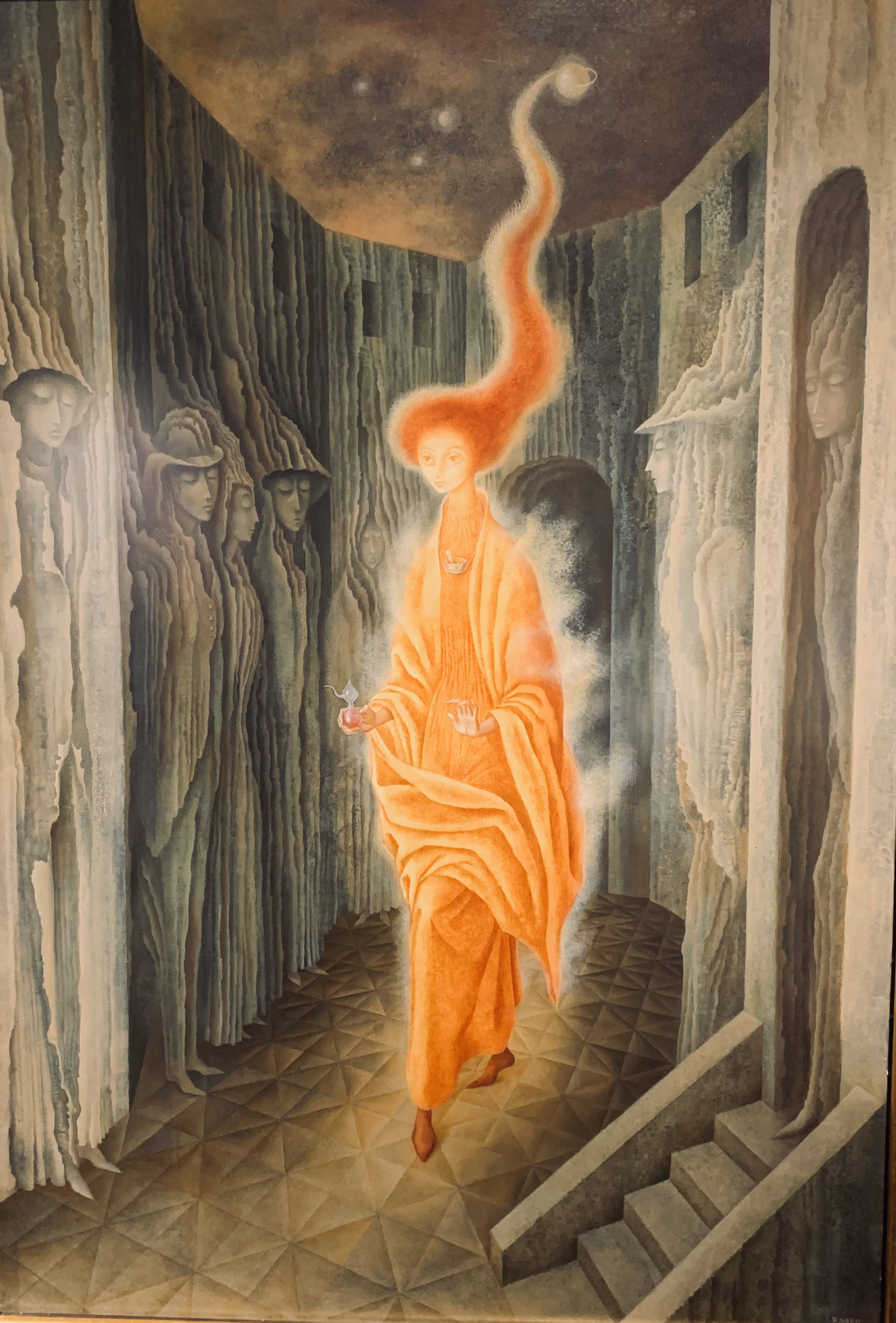
La llamada (The Call), Remedios Varo, 1961
I was reading Exit Opera, Kim Addonizio’s latest book of poems, when I came across the following lines from “20.5 Light Years from Earth:”
“Sometimes writing feels so stupid I think I should get out into the world & do something
like repairing fountain pens, milking snakes, something useful—
sexing chickens, dyeing lemons—fecal pathobiologist is another job I could maybe do
if only I would slide off my couch & stop reading & writing so much.”
I have days like that too. I think about all the time I’ve spent agonizing over the placement of a semicolon, or whether a title made sense, or if x was a relevant metaphor for y. I ask myself, why am I doing this? What use is it? Does anyone really care?
Then I ponder the random collection of skills I’ve accumulated over the years of my life and wonder if any of them could be called “jobs.” Maybe a few; none so weirdly offbeat as the list in Addonizio’s poem. But I’m wary of turning hobbies like gardening, sewing, or drawing into a job. That seems like a sure-fire way to take all the fun out of an activity meant to be joyful. As Oliver Burkeman wrote in Four Thousand Weeks, “The capitalist pressure to commodify your time robs your life of any meaning and renders you almost incapable of conceiving activities that can’t be commodified as something worth doing at all.”
Being a poet is not always fun or joyful. It’s not rewarding in any conventional way. But the unconventional rewards are endless. It’s the best way I know to make sense of things, to stay in the present, and to resist the capitalistic urge to monetize every minute of one’s life. It forces me to be patient. It sends me on quests for just the right words, phrases, or forms. It teaches me to heed my dreams.
In her “Address to New York City High School Prizewinners,” given at Washington Irving High School in April 1979, Denise Levertov wrote, “When one discovers that one has a gift for writing poetry it’s a solemn and also a deliriously exciting moment. Maybe many moments—because sometimes you don’t believe it and then you discover it over again. One feels chosen—and if one has an adequate recognition of poetry being something larger than oneself, one feels a sense of dedication to the calling of poet.”
I would agree that among the poets I know, what we do feels larger than ourselves. We don’t always understand what we’re doing or why we’re doing it, which is, of course, part of the allure.
If I were to give an honest answer to someone asking me why I wrote poems, it would be a paraphrase of Emily Dickinson’s famous quote: “I write poems to feel the top of my head fly off.”

I still don’t completely understand where a poem comes from or how it gets into my head. I just know it happens.
Oh yes Andrew. Then the scramble for pen/paper! Mind you- I type a lot into my phone.
The fun part of it is: you never know what you’re up to or up against. What’s shown you is almost always a small part of the beast and you return days later to wonder how you tamed it to become a beautiful pet.
It leaves in awe of where it came from and how you were able to midwife the arrival.