
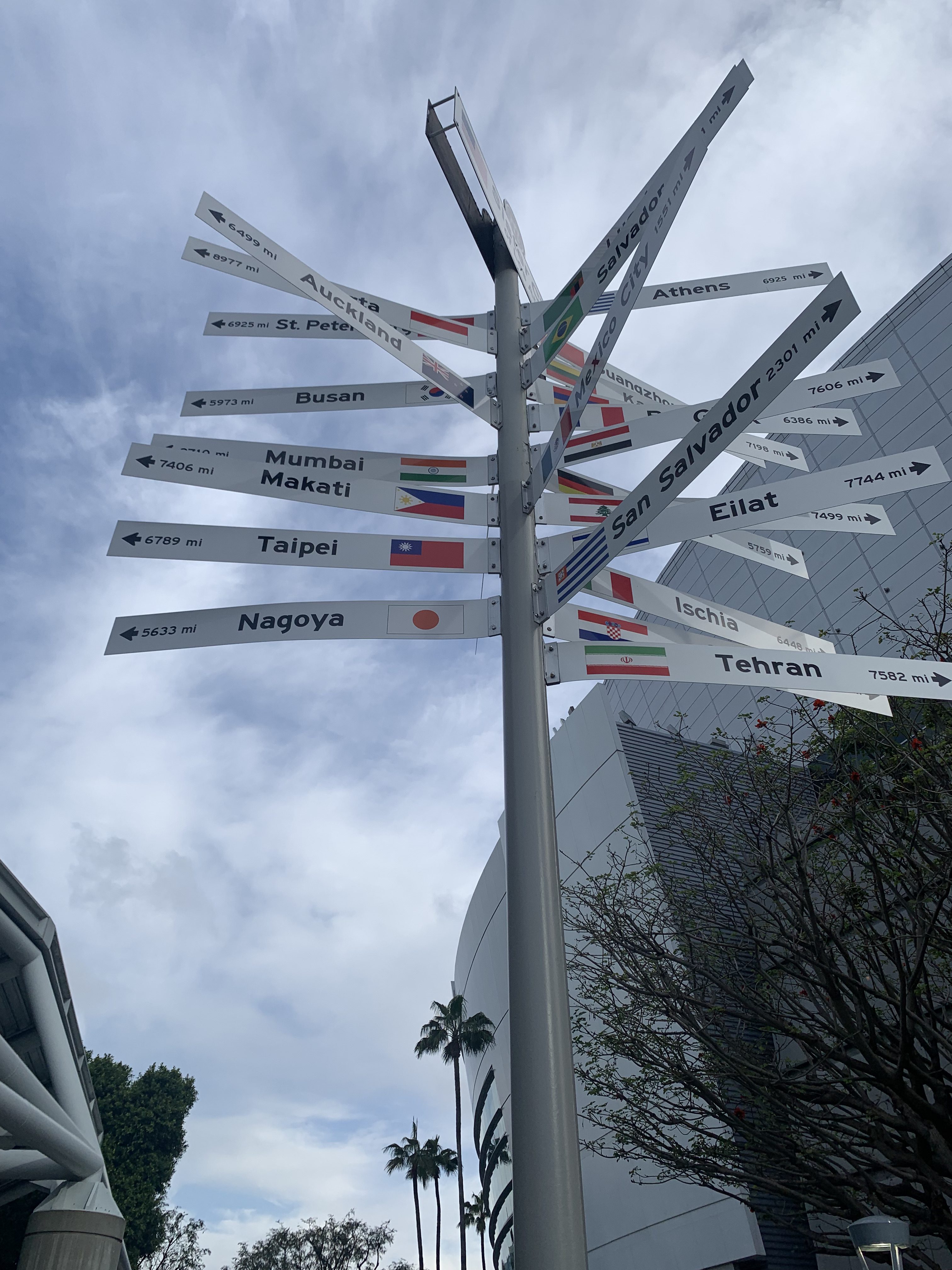
Sister cities of Los Angeles
Second of a three-part series.
The first post in this series ended with the fourth panel of Day 1, “From Satire to Dad Jokes: How Humor Can Be Literary, Political and Funny.” The fifth panel I attended on the first day of AWP 2025 was “Still Surreal: A Poetics of Revolution” (C. Francis Fisher, Joyelle McSweeney, Danielle Pafunda, Will Alexander). It was 3:20 pm, the fifth panel of the day, I hadn’t had anything to eat since breakfast, the room was warm, and my brain was processing the ideas from the previous four panels. I had a harder time paying attention, but I did absorb some of the information the panelists shared.
For example, 2024 was the centennial of Surrealism, and the movement has never left, or as Will Alexander put it, “Surrealism never concludes.” As Andre Breton, the founder of Surrealism said, “Beauty will be convulsive or it will not be at all.” The panelists asked the audience if we read in our dreams, and did we dream “usable things?” Poetry brings us into the realm of dreams, one of the aims of Surrealism. We must cede cognitive control to let creativity flourish.
I began Day 2 of the conference with “Eyes Wide: Exploring the Extended Ekphrastic” (Tess Taylor, Victoria Chang, Tyree Daye, Dean Rader, Allison Rollins). This panel was a high point for me, as it featured five excellent poets who also write ekphrastic poetry. Victoria Chang was commissioned by the MOMA to write poetry in response to the art of Agnes Martin. The result, With My Back to the World, is a collection of elliptical, mysterious poems that seem to fit the cool detachment of Martin’s art. As Chang said, “Being looked at is good for a work of art.”
I was most impressed with Dean Rader’s presentation about the creation of his book, Before the Borderless: Dialogues with the Art of Cy Twombly. Twombly was “famously inscrutable,” his art often consisting of scribbles, erasures, graffiti, and collage. Yet from this art, Rader was able to create a series of moving, deeply personal poems. Here are the first lines from “Unfinished Unending Journey:” “In the middle of our life, / we never know it is the middle. // It terrifies my son the sea has no center and no end.”
The second panel of the second day, “From Dusk till Dawn: Exploring Nocturnes & Aubades”(Amy Ash, Amorak Huey, Curtis L. Crisler, Tatiana Johnson-Boria, Kevin McKelvey) was unexpectedly generative for me. I’d been working on a poem that took place on an early winter evening. As I listened to the panelists, I realized that this poem was a nocturne. This nudged me in a new direction, allowing me a fresh perspective. The aubade and nocturne offer opportunities for innovation, drama and possibility; they are emotionally evocative; they can function like Richard Hugo’s triggering town.
I ended the day with “Crafting the Memoir in Essays” (Nicole Graev Lipson, Eiren Caffall, Freda Epum, Emily Raboteau, José Vadi, Erica Berry). This panel exposed me to some excellent books which are now on my to-read list. I also found it valuable for guidance in structuring a work of essays. For example, if you’ve written a bunch of personal essays and you think you have a book, the first things an editor will ask is, “what is the common thread in these essays?” and “how do these essays function as chapters in a book?” The main difference between a chapter and an essay is that a chapter is incomplete while an essay is complete. So the memoir-in-essays needs to spark interest in readers to keep them going. Or, as one of the panelists put it, a chapter is breadcrumbs while an essay is tapas.
Next post: Future forms for poetry, the black ekphrastic mode, and the AWP Bookfair.

A great report–these were all interesting ones I didn’t make it to! I find that my ability to pay a good quality of attention fades by the end of the third panel, so you have stamina.