

In 2015, I inherited a collection of Poetry magazines from a relative who’d just died. Dated June 1993 to May 1997, these slender little books—nine inches long by five-and-a-half inches wide and an eighth of an inch thick—contain many of the prominent voices in poetry during that period. Their names appear on the covers, in capitals and sorted alphabetically by last name, as in the list from the June 1993 issue in the image above.
Seven of these nineteen poets, translators and reviewers have died since this issue was published: John Ashbery, R. G. Barnes, Jorge Luis Borges, Pierre Martory, William Matthews, W. S. Merwin, and Robert Richman (Dante has been dead since 1321).
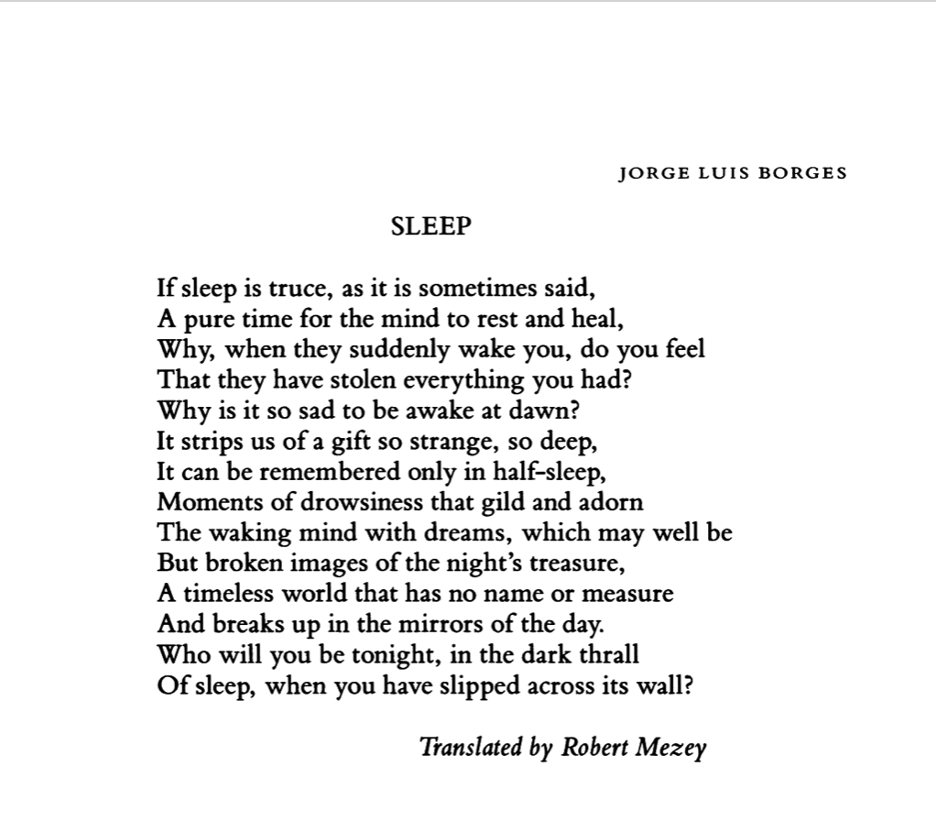
It doesn’t escape me that this particular issue contains only male poets. These earlier issues tend to feature the same group of men. But I still enjoy reading them, pulling one from the shelf next to my desk and finding a jewel like John Ashbery’s “Strange Things Happen at Night,” which begins, “Without thinking too much about it, / prepare to go out into the city of your dreams,” or one of my favorite Borges poems, “Sleep,” translated by Robert Mezey:
When I started my newsletter, Sticks & Stones, in 2018, I decided to include one poem in each issue from a poet who’d shuffled off this mortal coil. It’s a way to honor these writers, many of whom were not celebrated, who didn’t appear in Poetry, who worked in relative obscurity but deserve to be read by more people. In my search for poets to feature, I’ve come across names that were new to me, such as Wendy Battin, Nagase Kiyoko, Matthew Henriksen and Oscar Venceslas Lubicz-Milosz.
My bookshelves hold many more poets who have left us: Marvin Bell, Denise Levertov, Wanda Coleman, Seamus Heaney, Donald Hall, Wislawa Szymborska, Tomas Tranströmer, Sylvia Plath, Rainer Maria Rilke. I’ve found solace, insight, and inspiration in these pages. Their poems are so vital, so alive with imagery and emotion, that I must remind myself that while their work continues, the poets themselves are gone. No more will come from them.
The best way that I can think of to honor these dead poets is to crack open those dusty books and read the poems they left us. By doing so, we enter not only into their hearts, minds and imaginations, but into the historical periods they inhabited. Through the poems and essays of Nagase Kiyoko, for example, we absorb joys and frustrations of a woman living in 1940s Japan, while Wanda Coleman shows us the struggles of a single mother. Seamus Heaney writes of The Troubles in Northern Ireland. Rilke tries to “reconcile beauty and suffering.”
As Irina Ratushinskaya (Russian, 1954-2017) wrote in “Pencil Letter,” “The page will be / In shreds as soon as I have scribbled it.” Life, and paper, are short, but poetry lives on.
So search for those dead poets, read their work, absorb their words. Honor them.

1 thought on “Honoring Dead Poets”