
I am a fan of the writer Leslie Jamison. I’ve read much of her work, starting with The Empathy Exams, in which she writes about her “experience as a medical actor who was paid to act out symptoms for medical students to diagnose.” I had never heard of medical actors before I read the essay, nor an exam to measure the amount of empathy a prospective doctor displayed, but I found the idea both fascinating and disturbing. What if the results of our doctors’ empathy exams were posted on the walls of waiting rooms? How would it affect the choices we made in who we chose to care for us?
Reading the essay reminded me that as a woman I am expected to automatically display more empathy than my male counterparts, to be more understanding, to give in when I didn’t necessarily want to, to say “yes” when I want to say “no.”
When I read Jamison’s article, “How a Notebook Taught Me to Embrace Saying No,” I remembered “The Empathy Exams.” I thought about the message I’d absorbed as a girl growing up in the 1960s: that my primary function was to put my desires aside and help other people. It’s no surprise, then, that I and countless other women have trouble saying “no.”
Jamison puts it this way: “The inability to say no was tangled with other things: a mercantilist desire to shore up affection, gratitude and opportunities, and a craven, self-centered fear that I would be annihilated by someone else’s hurt or disapproval.” The last point resonated with me: that I couldn’t bear the emotional wallop of being honest enough to decline.
“It was not only my right but also my responsibility to draw my own boundaries,” Jamison writes, “rather than expect another person to draw them for me.” This is perhaps the most important point in the article.
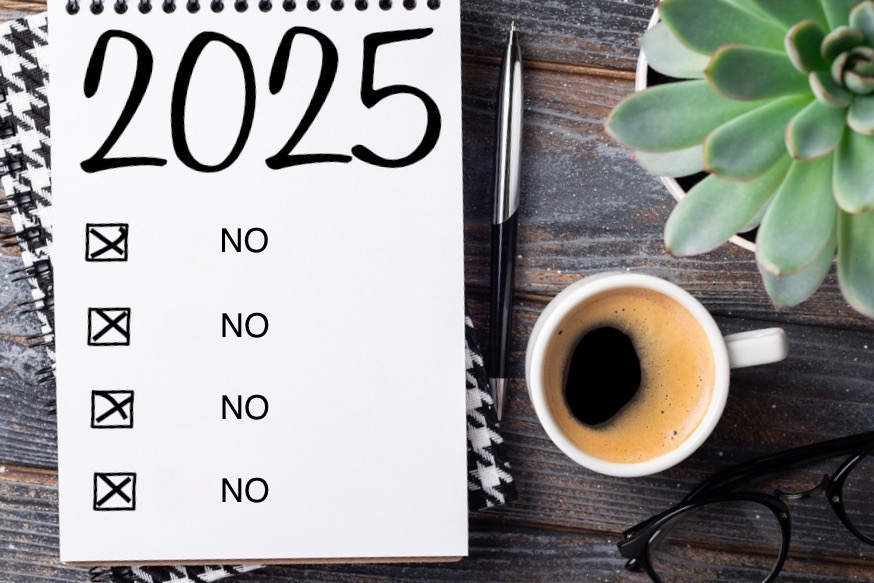
To sustain her say-no pledge, Jamison kept a notebook of things she said no to: “I decided to make something I called the ‘Notebook of Noes.’ On every page, I wrote down an opportunity I had decided to decline: a speaking gig, a magazine commission, an invitation from a friend. Then I drew a line across the page. Underneath, I wrote what saying no had made room for: more time with my partner. More time at home. More time to write. More time to call my mother and ask about her day, and tell her about mine.”
Near the end of the article, Jamison reflects, “The flip side of saying no is saying yes more fully, less grudgingly — because I’m not living life like a pat of butter spread too thinly across toast.” I like the concept of seeing the opportunities in a list of refusals. For every “no,” there’s an implied “yes.”
Saying no imposes order into our lives. It reminds me of the negative space surrounding words on a page. That space holds the words together so they can form meaning in a reader’s mind. Without it, we would have a confusing bunch of ideas running from edge to edge.
Saying no is empowering. It gives you back your time. It’s wildly liberating. Now that I’m in my 60s, I am acutely aware of my mortality. I know I have far less time left on Earth to do the work I want to. I must say no. And mean it.
Have you found that saying no leads to more yeses? Please share in the comments.

I find saying no liberating. I am learning that I don’t need the qualify the no with a reason. I just say “I’m unable to make it/attend” and leave it at that. Leaves more room for the many yes’s that I want to actually do… I do always say yes, though, to any invitations when I am traveling overseas. Every yes overseas leads to a deeper understanding of the people I am visiting.